Placement vs. ownership
Dispensary ATM placement or owning your ATM: which arrangement fits?
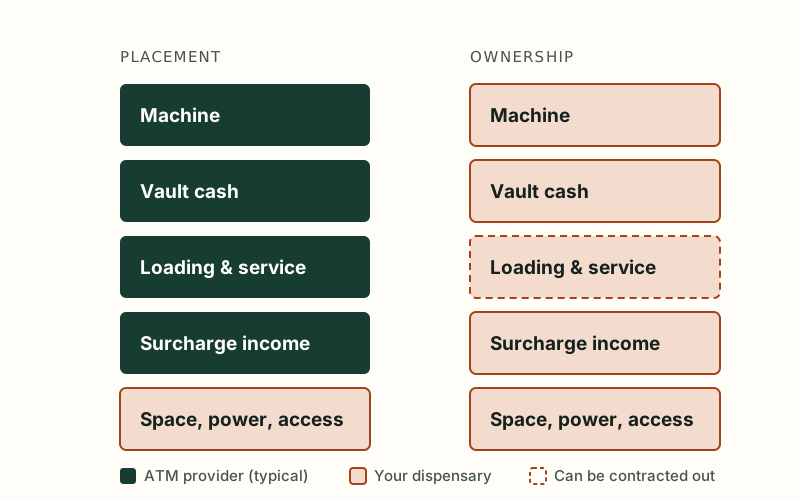
The ATM is the same box either way. What changes is whose money is inside it, who keeps the surcharge and who does the work.
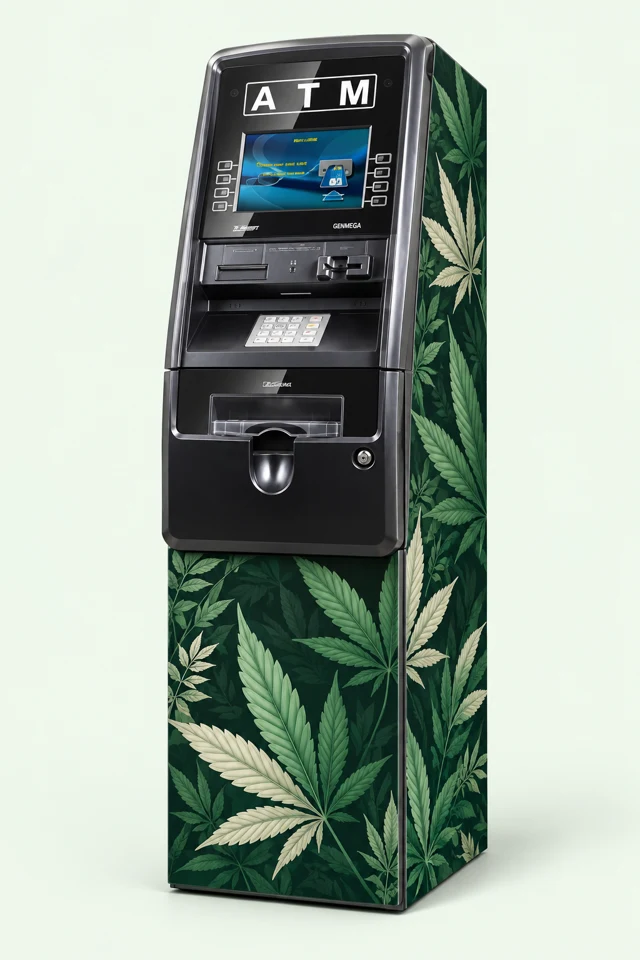
Final artwork and fit require approval.
We get our wraps from Get Branded.
Illustrative wrap concept.
The short answer
With placement, an ATM provider usually owns the machine, funds and loads the cash, handles service and keeps most or all of the surcharge; your dispensary provides the space. With ownership, you buy the machine, fund the cash, sign the processing agreement and keep the surcharge income after your costs. The right choice depends on how much cash, staff time and risk you want to take on.
Side-by-side
| Responsibility | ATM placement | Owning the ATM |
|---|---|---|
| Who owns the ATM | The provider | Your dispensary |
| Upfront equipment cost | Usually none for the store | Purchase price, delivery and installation |
| Cash inside the machine | Usually the provider’s money; some agreements ask the store to fund it for a larger share | Your money |
| Loading the cash | Provider or its cash-service partner | Your staff or a cash-service company you hire |
| Watching cash levels | Provider, through its monitoring | You, through the processor’s reporting and alerts |
| Surcharge income | Provider keeps it, or shares an agreed portion with you | You set it within processor and network rules and keep it, less costs |
| Processing agreement | Provider’s | In your business’s name |
| Repairs, parts, receipt paper | Provider, as the agreement describes | You, or a service agreement you buy |
| Equipment and software updates | Provider | You |
| Your obligations | Space, power, a connection if needed, access for service, and the contract term | Everything above, plus your state’s premises rules |
| Leaving the arrangement | Term, renewal and termination clauses decide | You can sell or move the machine; processing has its own contract terms |
Typical arrangements in the ATM industry. Your signed agreement decides who does what.
How placement works
A placement provider installs an ATM it owns in your store and runs it: cash, loading, monitoring, repairs and processing. The provider earns the surcharge customers pay, and the agreement says whether a share comes back to the dispensary.
Placements come in more than one form. Ask which one you are being offered:
- Provider-funded placement. The provider’s money is in the machine and its team or cash-service partner loads it. The least work for your staff.
- Store-funded placement. The provider owns and services the machine, but your dispensary supplies and loads the cash, usually in exchange for a larger share of the surcharge.
- Revenue share. Whatever the funding, the split of surcharge — and any per-transaction amounts — should be written down, with how and when you are paid.
What ownership involves
Buying an ATM gives you the equipment and the surcharge income, and with them the work. You fund the cash and decide who loads it, sign a processing agreement in your business’s name, set a surcharge within your processor’s and the networks’ rules, and arrange repairs and supplies.
Ownership tends to make sense when withdrawal volume is steady enough to cover the machine and your costs, when you have people and procedures to handle cash securely, or when you run several locations and want one consistent setup. If you want to look at equipment, ATMMachines.com lists current ATM models.
Which fits your store
| Placement often fits when… | Ownership often fits when… |
|---|---|
| You are opening or newly licensed and do not know your volume yet | You have months of steady withdrawal history |
| You would rather not tie up cash in a machine | You can fund the cash without straining operations |
| Staff time and cash handling are already stretched | You have trained people and controls for handling cash |
| You want one party responsible for the whole machine | You want the surcharge income and control of the setup |
Dispensary-specific checks
- Your state’s premises rules. Some states address ATMs, cash or camera coverage on licensed premises. Check our state rules resource and your compliance lead before choosing a spot.
- Public-assistance (EBT) card restrictions. Some states bar welfare cash withdrawals at cannabis stores, including at their ATMs. Among the provisions we verified, Colorado also requires a posted notice at the machine. See state rules, and ask your provider or processor how EBT cards will be blocked.
- Processing fit. Not every processor works with cannabis merchants. See cannabis ATM processing.
- Your lease and insurer. Bolting equipment to the floor, adding a data line and holding extra cash on site can involve your landlord and your insurance policy.
- An existing agreement. If a machine is already in the store, find its term, renewal date and termination clause before you sign anything new.
- Several locations in different states. Each location follows its own state’s rules; one agreement may not fit all of them.
Through this site you can discuss placement, buying an ATM or a processing review. Availability, equipment and terms are confirmed for each location. Nothing here is an offer or a promise of approval.
Next step
Talk through the ATM for your dispensary.
Tell us your state, your license status and what you have today. We’ll walk through placement, ownership or a processing review and confirm what is available for your location.